
From Blind Faults to Instant Intelligence
How Red Neuron Lab onboarded a chiller manufacturer's legacy relay-based fleet onto a real-time IoT monitoring platform, without replacing a single piece of hardware.
A chiller maker whose machines can't afford downtime
National Cooling Systems is a chiller manufacturer with significant annual production capacity, supplying industrial and commercial cooling equipment across the region. Their machines power critical infrastructure (process cooling, HVAC, and cold chain), where any unplanned downtime directly impacts customer operations.
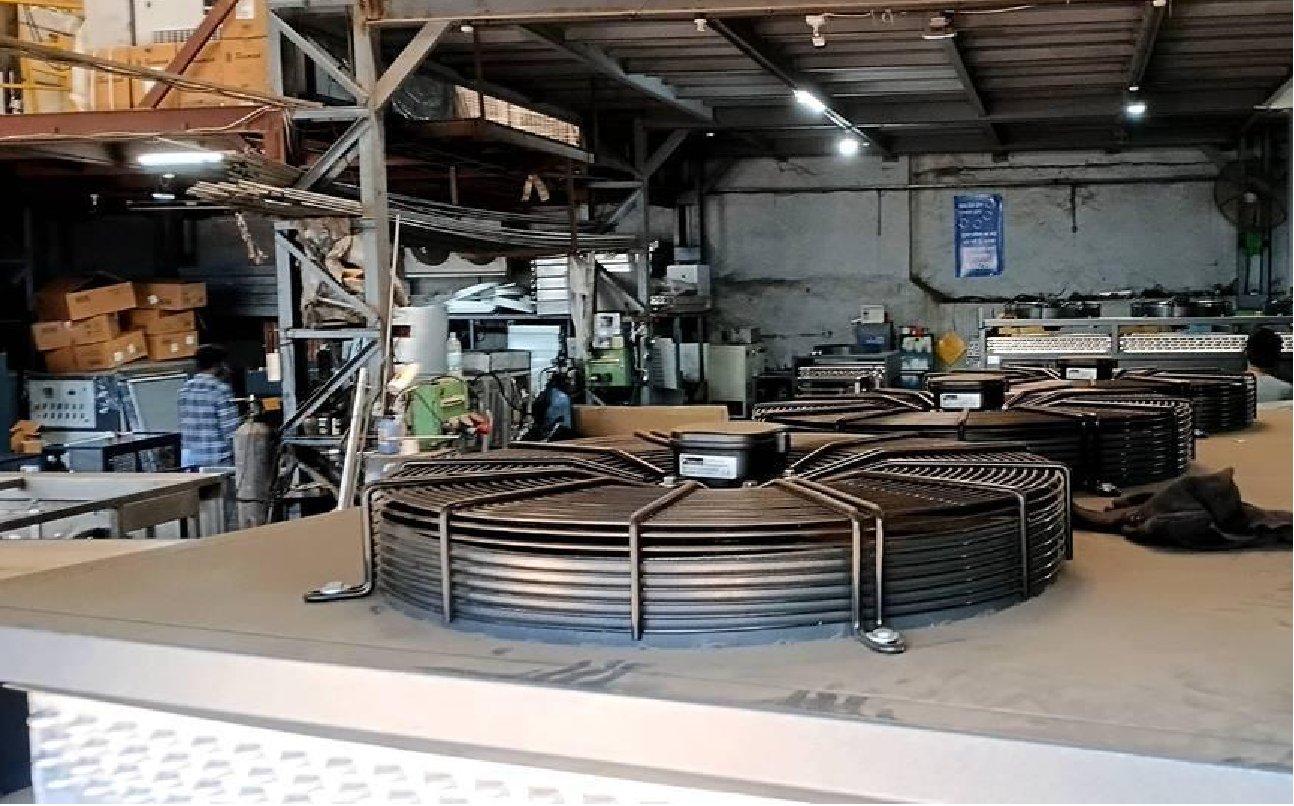
Most of the fleet was invisible
When Red Neuron Lab evaluated their fleet, a striking gap emerged.
Relay-based control logic
(no digital protocol)
Modbus-enabled
(digital monitoring ready)
The vast majority of their installed fleet was effectively invisible to remote diagnostics. No structured data, no telemetry: just physical relay contacts switching ON and OFF, with a support team left flying blind when things went wrong.
Every fault started a slow, manual chain
Every chiller failure triggered a multi-step escalation. By the time the right expert had enough context to help, the customer had already been waiting, and the situation may have already worsened.
The old fault response workflow
- Chiller fault occurs
- Customer calls the business owner
- Owner re-routes the call to the technical team, adding delay and losing context
- Technical team asks the customer to photograph the control panel
- Engineer manually interprets which relay indicators are ON or OFF from the photo
- Remote guidance is provided, or a site visit is dispatched for complex faults
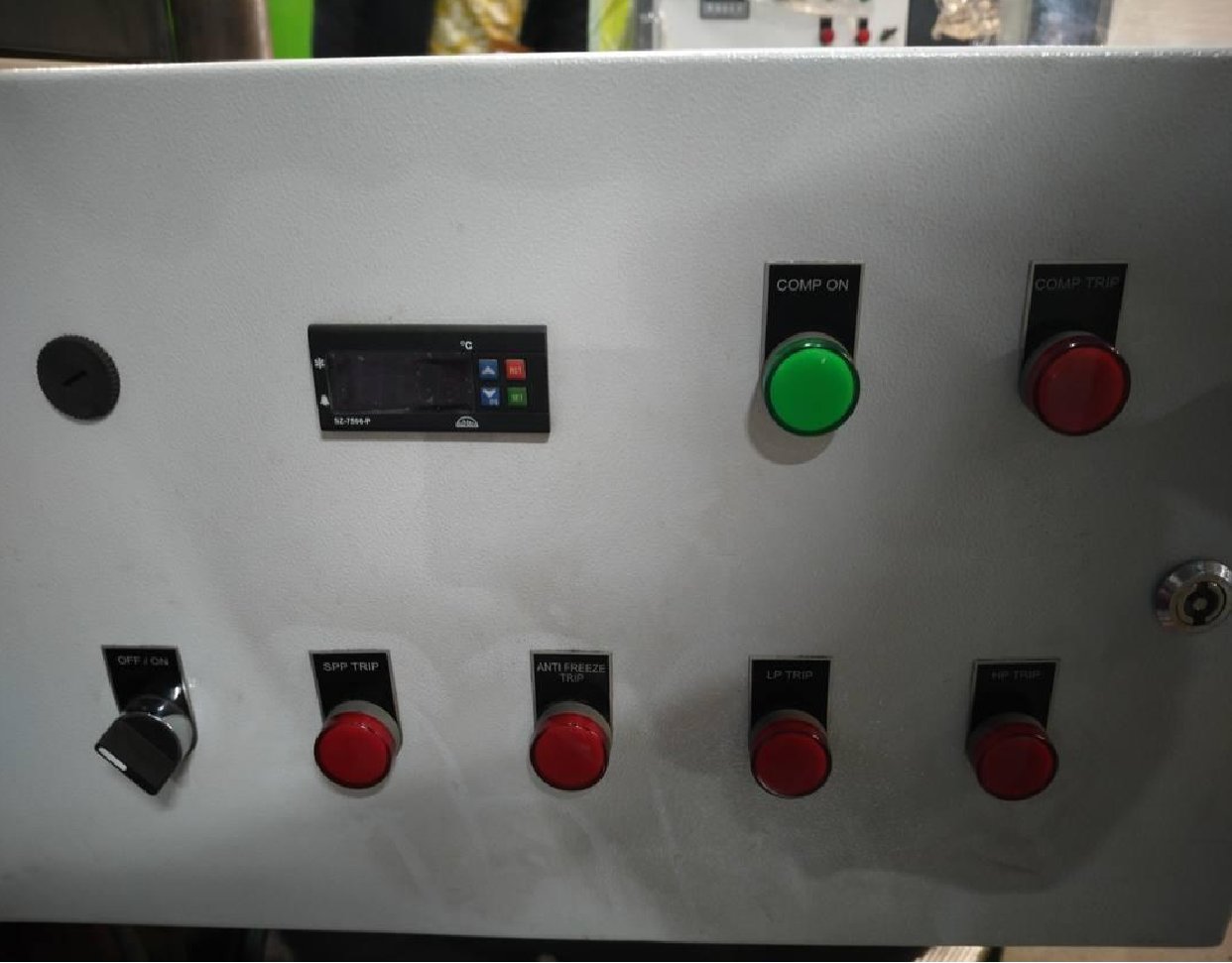
What the support team was working from
This panel was the only window the support team had into a machine's fault state. Engineers had to read indicator lamp positions from a smartphone photo taken by a non-technical customer.
The five fault indicators (Compressor Trip, SPP Trip, Anti-Freeze Trip, Low Pressure Trip and High Pressure Trip) represent every major failure mode of the chiller. Each one lights a red lamp. Decoding this remotely, from a photo, is inherently error-prone and slow.
Why the old way was costing them
Delayed fault response
A multi-step human relay introduced significant lag before diagnosis even began.
Blind diagnostics
Engineers reconstructed machine state from a blurry panel photograph.
Costly site dispatches
Without remote clarity, many cases defaulted to physical visits.
Owner as bottleneck
Every fault call was funnelled through the business owner.
No protocol upgrade path
With 99% of machines on relay logic, conventional IoT platforms were incompatible.
Read the relays the chiller already has
The key insight was that all fault information already existed inside the chiller, encoded in the state of the AC relay contacts on the control panel. Red Neuron Lab's platform converts those binary relay states into structured digital signals, streams them to the cloud, and triggers intelligent notifications the moment anything changes.
Site assessment
Before proposing a solution, our team physically evaluated the chillers on-site, inspecting the refrigerant circuits, mechanical assemblies, electrical control panels, and manufacturing infrastructure.
Technical approach
- AC relay contact reading: existing relay output contacts are read as binary digital inputs, with no modification to the chiller's original control logic.
- Opto-isolated digital input module: safely decouples high-voltage relay signals from the low-voltage IoT electronics.
- Compact SMPS power supply: powers the monitoring module from the panel's existing supply rail.
- Wireless IoT gateway: the edge device transmits relay state data to the HiveProvisioner cloud platform over cellular or Wi-Fi.
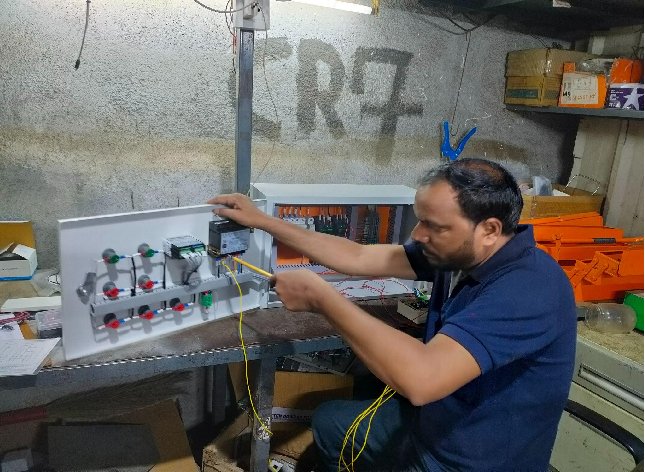
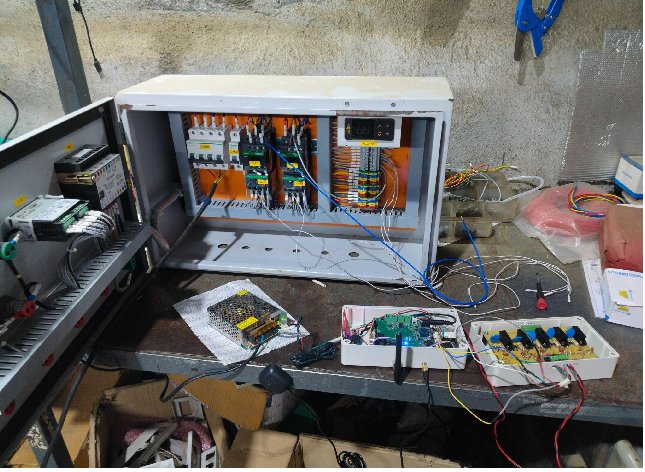
One chiller. One session. Live alerts.
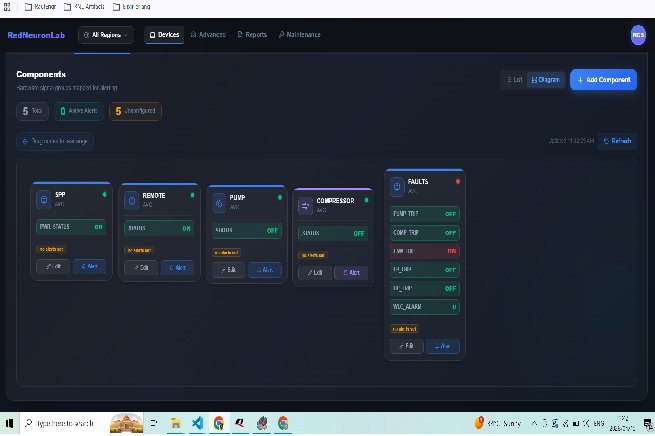
Red Neuron Lab proposed a live POC directly at the National Cooling Systems facility. One chiller was selected. Our team tapped the existing relay output contacts from the terminal block, connected the digital input module, configured the wireless gateway, and registered the machine on the platform, all within a single session.
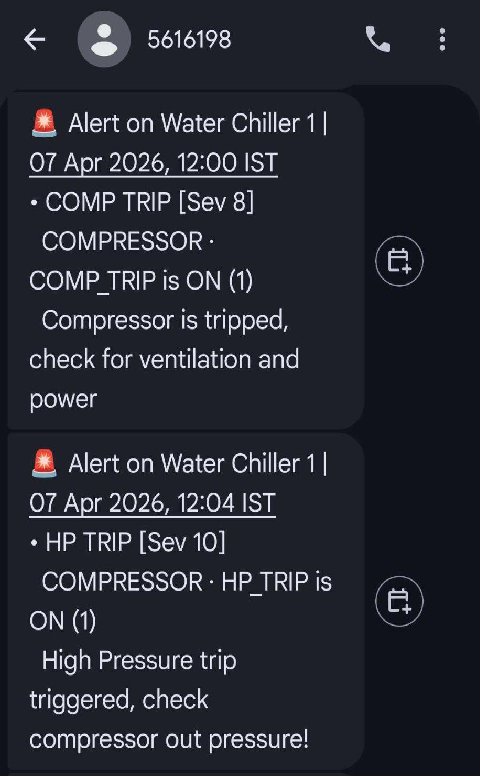
A simulated fault was then triggered at the panel. Within seconds, the platform detected the relay state change and fired SMS, WhatsApp, and email alerts to the configured support team contacts, with full fault context. The team at National Cooling Systems witnessed the complete flow live.
From relay click to engineer's phone
- Relay signal detectedA fault condition changes the state of an existing relay contact on the chiller's control panel: compressor trip, high pressure, low pressure, SPP trip, anti-freeze, or any other configured signal.
- Binary input capturedThe digital input module reads the ON/OFF state change and packages it with a precise timestamp.
- Cloud platform receives dataThe IoT gateway transmits the event to HiveProvisioner, which maps it to a specific fault type using the configured signal dictionary.
- Multi-channel alert firesSMS, WhatsApp, and email notifications reach the configured support team contacts before the customer even picks up the phone.
- Support team responds with contextThe engineer already knows the machine, the site, and the exact fault. The customer call, if it comes, is met with an answer, not a question.
Alert channels
SMS
Instant text to field technicians. Works in low-connectivity areas. No app required.
Rich message into the team's existing WhatsApp workflow. Zero new tools to install.
A documented fault report to the support team, and optionally the customer.
What changed for National Cooling Systems
Zero calls through the owner
Fault alerts route directly to the technical team. The business owner is removed from the first-response loop entirely.
< 30 seconds alert delivery
From relay state change to SMS, WhatsApp, and email in the support team's hands.
100% signal clarity
Every fault channel is pre-decoded on the platform. The exact fault is named and timestamped, with no photo interpretation required.
Entire fleet now monitorable
The relay-reading approach means the 99% of machines that conventional IoT platforms would have ignored are now fully eligible for real-time monitoring.
Reduced site dispatches
With the team informed and the fault identified before the conversation starts, many cases that previously required a visit can be resolved remotely.
Minutes to onboard each machine
Machine registration, signal mapping, and alert configuration are completed within a single session, with no engineering lead time.
For every chiller manufacturer
The National Cooling Systems engagement revealed a pattern that applies across the entire chiller and industrial cooling sector. If your installed fleet looks anything like theirs, the opportunity is significant.
- Your relay signals are already telling you everything. Every fault is encoded in the relay contacts on your control panels. You are generating the data; Red Neuron Lab gives you the ability to read it remotely.
- No Modbus? No problem. Modbus-enabled machines represent 1–5% of fielded chiller inventory. The remaining 95–99% run on relay logic, and our platform is built specifically for this majority.
- Proactive support as a competitive advantage. The manufacturer who resolves a fault before the customer realises it happened wins loyalty no product specification can buy.
- No capital expenditure on machine redesign. No panel redesign, no PLC replacement, no firmware update. Add-on, not swap-out.
- Scalable across your entire fleet. Each machine onboards in minutes. Contact routing, signal mapping, and machine profiles are fully configurable by your own team.
- A new value-added service offering. Bundle IoT-enabled monitoring into your service offering and stand out in a market where hardware specifications are increasingly commoditised.
Ready to make your fleet observable?
We offer a proof of concept at your facility. One chiller. One session. Live fault alerts before you leave the room.